EN
EN

In manufacturing workshops, many efficiency problems do not come from the processing equipment itself. They often appear in an easily overlooked area: material flow.
Parts move from the warehouse to workstations, from assembly to inspection, and then from inspection to shipping. It may look like a simple matter of moving items from one place to another, but when the frequency is high, the distance is long, and the load is heavy, material handling becomes a hidden obstacle in the production rhythm.
Manual handling not only takes up employees' time, but also interrupts the work they are already doing. This is especially true for heavy pallets, material boxes, and semi-finished workpieces. When these tasks rely on manual carts, carrying, and waiting for long periods of time, three problems are likely to occur:
First, the production rhythm becomes unstable.
When materials arrive often depends on personnel scheduling and how quickly the site responds.
Second, the workload on employees increases.
Repeated handling, long-distance walking, bending, lifting, and placing materials all increase fatigue and can also affect on-site safety.
Third, on-site management becomes less transparent.
Where the materials are, whether processing has been completed, and whether they can move to the next process are all questions that require clear records. Without systematic tracking, waiting, accumulation, and repeated confirmation can easily occur.
Therefore, optimizing material flow is not simply about replacing people with equipment. It is about changing the production process from 'people looking for materials and materials waiting for people' to 'materials moving according to rhythm and equipment connecting processes proactively.'
1. Low-Cost Automation Does Not Mean Low-Level Automation
When many companies hear the word automation, their first reaction is high investment, long implementation cycles, and difficult renovation.
In actual production, however, not every process requires a complex and expensive full-line transformation. Material transfer, workstation docking, material box buffering, and semi-finished product circulation are especially suitable for a low-cost automation approach.
The core of low-cost automation is not to make the system as complicated as possible. Instead, problems that can be solved with mechanical structures should be solved with mechanical structures, while issues that must be coordinated by a control system should be handled by sensors, software, and dispatching systems.
For example, in material box conveying and buffering, roller tracks, inclined structures, positioning mechanisms, and modular workstations can be used to allow materials to move partly by gravity. This reduces the need for complex actuators such as motors and cylinders, and also lowers later maintenance difficulty.
But low-cost automation does not mean using no electrical systems at all. When the system needs to determine whether a workstation is fully loaded, whether materials have completed the required storage period, or whether an AGV/AMR can enter the docking point, sensors and digital systems are needed.
A truly efficient solution is often a combination of mechanical structures, gravity conveying, mobile robots, and information systems.
2. From Manual Handling to Automatic Flow, the Key Is Connecting Workstations
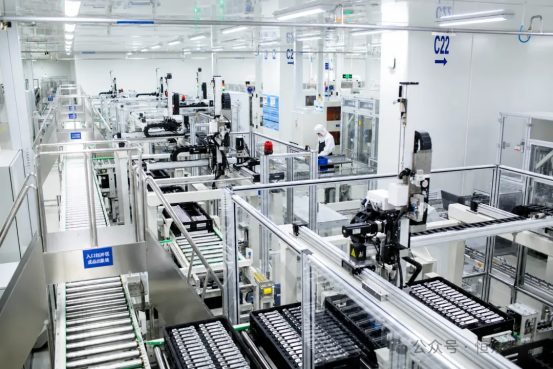
In traditional factories, materials usually move in separate stages.
The warehouse is managed by one group of people, assembly by another, inspection by another, and shipping by yet another area. Each process may operate normally on its own, but the connection between processes often still depends on manual handling.
The result is that every workstation may look reasonably efficient, but the entire process still does not run smoothly.
The value of automated material flow lies in connecting these isolated points.
A complete material flow solution usually includes several parts:
A warehouse for material storage and buffering.
Automated workstations for material delivery, temporary storage, and return.
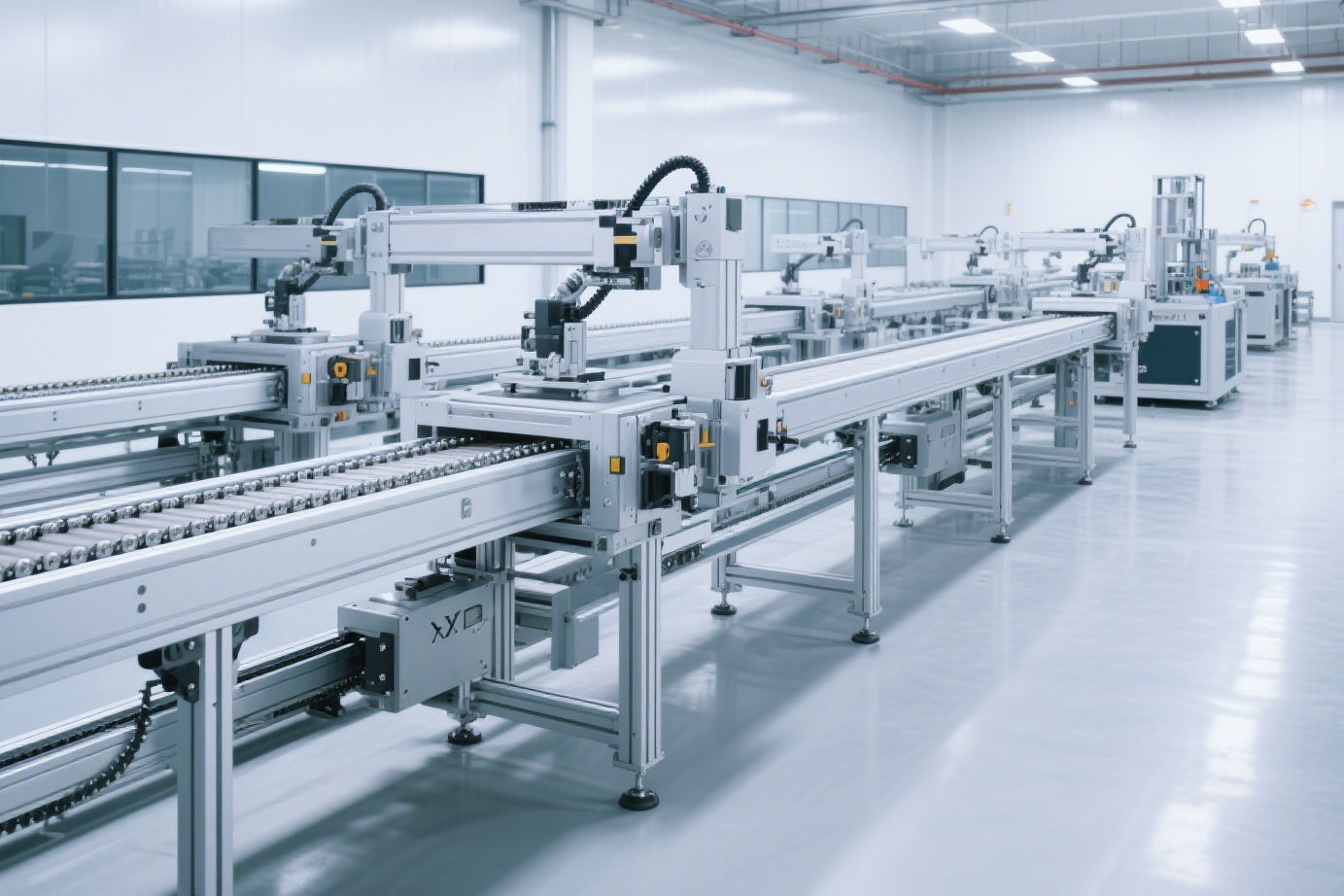
Roller tracks or conveying structures for low-resistance movement of material boxes and pallets.
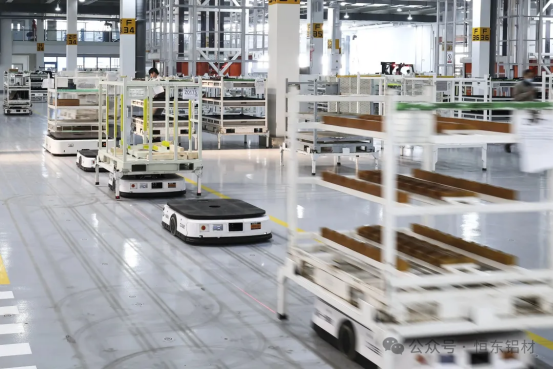
AMRs or AGVs for automatic transportation between different areas.
Sensors and dispatching systems for identifying workstation status, assigning transportation tasks, and recording material information.
In this way, materials no longer depend on someone temporarily moving them by hand. Instead, they automatically enter the next process according to the designed workflow.
For example, materials can be taken from the warehouse by a mobile robot and delivered to the assembly workstation. After assembly is completed, the carrier is moved to the next process. After inspection or curing, it returns to the warehouse or enters the shipping area.
During this process, employees no longer spend large amounts of time on material handling. They can focus on assembly, inspection, debugging, and other work that truly creates value.
3. Modular Aluminum Profiles Are an Important Foundation for Low-Cost Automation
In this type of material flow solution, aluminum profile structures often play a very important role.
The reason is simple: low-cost automation is not a one-time fixed project. It must be adjusted continuously according to the actual production site.
Today, the workstation height may be 750 mm. Tomorrow, if a different material box is used, the guiding structure may need to be adjusted.
At present, feeding may be done manually. Later, if AMR docking is added, positioning and lead-in space must be reserved.
If the current production rhythm is not high, simple buffering may be enough. When capacity increases later, more roller tracks, stopping mechanisms, and guarding structures may be required.
If everything is built with welded steel frames, later modifications will be costly.
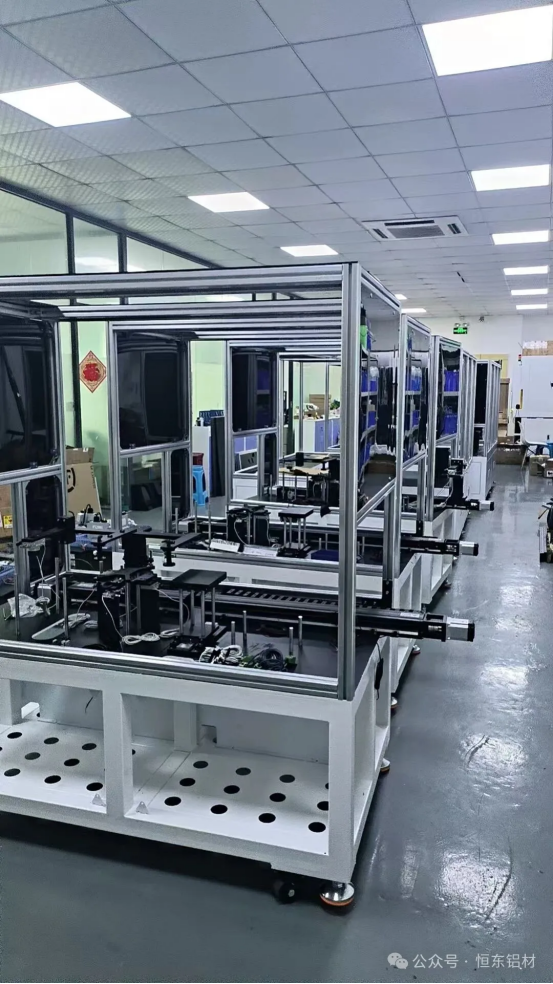
Industrial aluminum profiles, however, offer clear advantages: lightweight structure, high strength, fast installation, and easy adjustment. They can also be used with corner brackets, connectors, casters, door panels, guards, roller tracks, and other accessories to quickly build workstations, material racks, carts, buffer racks, and automation equipment frames.
For a material flow system, aluminum profiles are not just used to build a frame. They are part of the entire automation interface.
They must carry the weight of the goods while ensuring docking accuracy.
They must adapt to the site layout while remaining easy to maintain later.
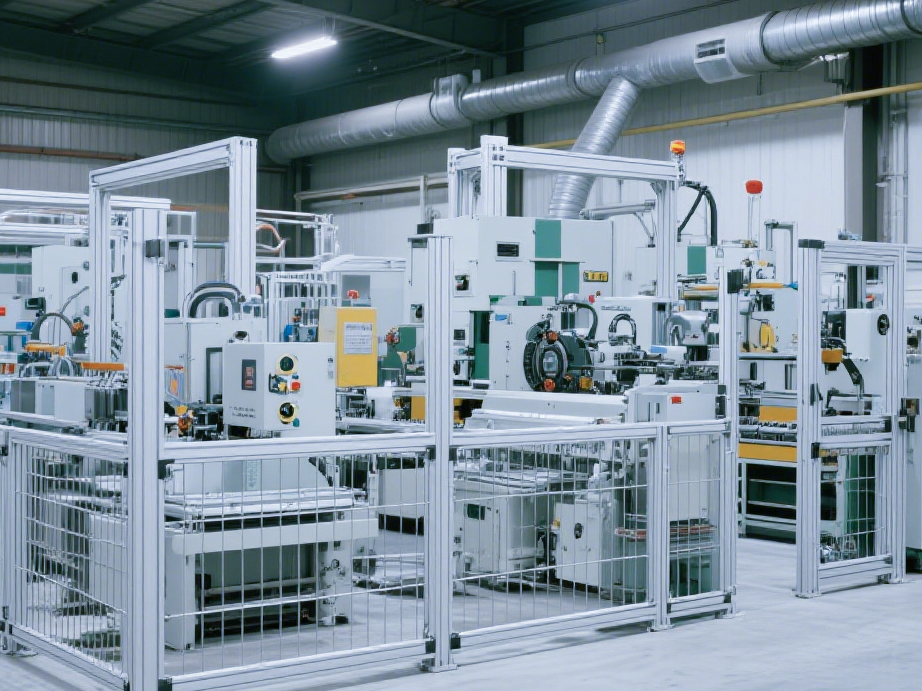
They must work with mechanical structures while also reserving positions for sensors, limit devices, stoppers, door panels, guarding, and other functions.
Therefore, even a seemingly simple material rack or workstation actually tests the overall understanding of structural design, site rhythm, and application scenarios.
4. Real Efficiency Improvement Comes from Less Waiting, Less Handling, and Fewer Interruptions
When many companies implement automation, they tend to focus only on the equipment itself: whether the cart runs fast enough, whether the robotic arm is expensive, or whether the conveyor line is long enough.
In real production, however, what matters more is whether the process is continuous.
A good material flow solution should achieve the following:
Materials do not pile up.
Workstations do not wait empty.
Employees do not repeatedly leave their posts to move materials.
The system knows the current status of each carrier.
Equipment can dock with other equipment stably instead of relying on manual adjustment each time.
Once these problems are solved, the changes on the production site become very clear:
Employees consume less physical energy and work more steadily.
Material flow becomes clearer and on-site management becomes easier.
The production rhythm becomes more controllable and waiting time is reduced.
Future expansion becomes easier, without needing to rebuild everything from the beginning each time.
This is also the most valuable part of low-cost automation. It does not aim to build a high-end unmanned workshop in one step. Instead, it starts with the most painful, most frequent, and most wasteful processes.
Start with one material rack, one workstation, one section of roller track, or one handling route.
Once material flow becomes smooth, the efficiency of the production site will gradually be released.
5. Manufacturing Upgrades Do Not Have to Start with Large Projects
For many small and medium-sized manufacturing companies, the most practical path to automation is not to complete everything at once, but to proceed in stages.
Step 1: Identify the most frequent handling routes on site.
Which materials need to be transferred every day? Which workstations often wait for materials? Which processes consume the most labor?
Step 2: Determine which actions can be replaced by mechanical structures.
For example, buffering, sliding, guiding, positioning, and temporary storage can often be achieved through roller tracks, aluminum profile workstations, and simple mechanisms.
Step 3: Then consider whether mobile robots or conveying systems are needed.
If cross-area handling is frequent, the distance is long, and the rhythm is relatively stable, AMRs, AGVs, or conveyor lines can be introduced for connection.
Step 4: Reserve room for future expansion.
Workstation height, material box size, sensor mounting positions, protective door structures, and maintenance passages should all be considered in advance to avoid repeated modifications later.
Automation is not about replacing a specific person. It is about making on-site operations more stable, freeing employees from repetitive handling work, and making the production rhythm clearer.
Conclusion
In factories, efficiency improvement often does not come from one expensive piece of equipment, but from reorganizing the details of the process.
How materials arrive, how they move, where they stop, when they enter the next process, who determines their status, and how equipment docks with other equipment - these ordinary-looking questions determine whether the production site is truly efficient.
The value of low-cost automation is to make material flow smoother in a more flexible, adjustable, and site-oriented way.
For automation equipment frames, conveyor lines, workstation material racks, roller track structures, and industrial aluminum profile applications, the future focus is not only to build the structure, but also to make the structure truly participate in the production rhythm and become part of the intelligent manufacturing site.
Table of Contents
- 1. Low-Cost Automation Does Not Mean Low-Level Automation
- 2. From Manual Handling to Automatic Flow, the Key Is Connecting Workstations
- 3. Modular Aluminum Profiles Are an Important Foundation for Low-Cost Automation
- 4. Real Efficiency Improvement Comes from Less Waiting, Less Handling, and Fewer Interruptions
- 5. Manufacturing Upgrades Do Not Have to Start with Large Projects
- Conclusion