EN
EN

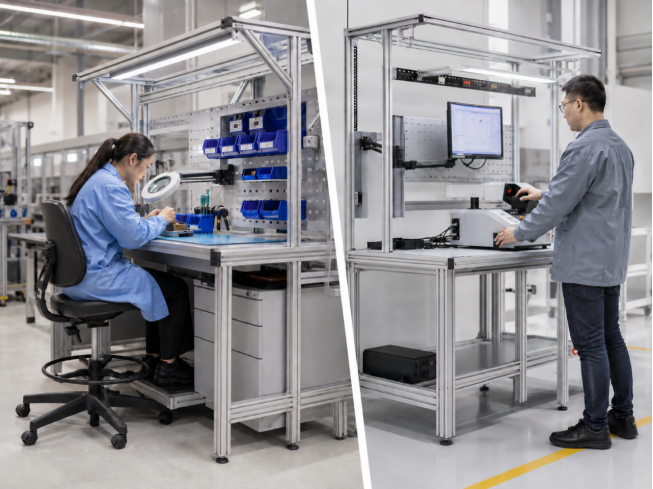
In many factories, a workbench is often seen simply as a table for placing things.
But when you actually walk through an assembly area, you will find that many efficiency problems do not start with the equipment. They start with the workstation.
Where should tools be placed?
Are materials properly classified?
Are cables and wires messy?
Do employees need to frequently stand up, turn around, bend over, or reach too far?
When switching to another product model, does the workstation need to be reorganized all over again?
These seemingly small issues accumulate day after day and eventually become the three most common problems on the shop floor:
Disorder, slowness, and fatigue.
Especially in scenarios such as electronic assembly, automation component assembly, medical devices, precision inspection, and laboratory operations, a workbench is no longer just ordinary furniture. It is an important workstation system that affects operating efficiency, assembly quality, and employee performance.
1. The Disorder in Assembly Areas Often Starts with Workstation Layout
As multi-variety, small-batch production becomes increasingly common, one assembly workstation often needs to handle different products, parts, tools, and work instructions.
If the workbench is not planned properly, the following problems can easily occur:
Tools pile up on the tabletop, making workers search through them repeatedly;
Small parts are not classified, which can lead to mixed materials or missed assembly steps;
Power cables, air tubes, and signal cables become tangled, affecting operation and creating safety risks;
Work orders, drawings, and inspection sheets have no fixed location and are easy to misplace;
During product changeovers, tools and materials need to be rearranged, wasting a lot of preparation time.
In many cases, the problem is not that employees do not know how to do the job. The real issue is that the working environment makes it difficult for them to work smoothly.
A good assembly workbench should not first be judged by whether it looks attractive, but by whether every tool, every material, and every document has a fixed place.
When tools are within easy reach, parts are clearly classified, and cables are routed neatly, workers naturally make fewer unnecessary movements, and the assembly rhythm becomes more stable.
2. Modular Workbenches Truly Solve the Problem of Difficult Changeovers
The biggest problem with traditional workbenches is that they are fixed.
Today the workstation may be used for Product A, and tomorrow for Product B. The tools, parts, and inspection requirements may all be different, but the workbench itself is often difficult to adjust quickly.
As a result, many workshops appear busy, but in reality, a large amount of time is consumed by preparation, searching, moving, and organizing.
This is where the advantages of a modular workbench become clear.
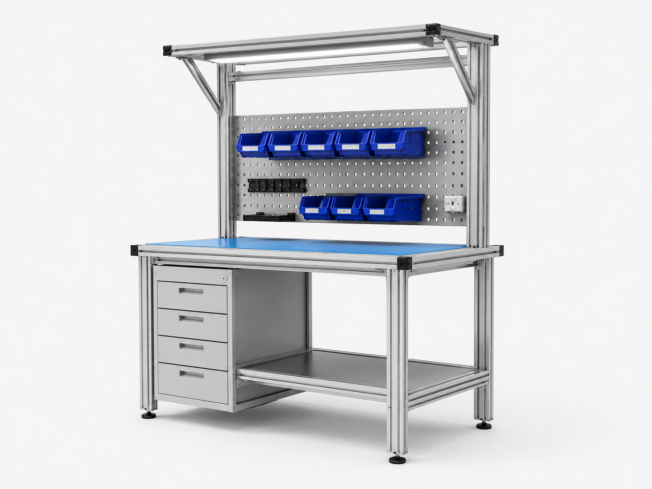
With an industrial aluminum profile frame, the workbench can be flexibly configured for different assembly scenarios:
An upper frame can be equipped with lighting, document holders, and tool boards;
The sides can be fitted with parts bins, air tube brackets, and power outlets;
The lower section can be configured with drawers, shelves, casters, or adjustable leveling feet;
The tabletop can be selected according to requirements, such as a standard tabletop, ESD-safe tabletop, wear-resistant tabletop, or easy-to-clean tabletop.
In this way, the workbench is no longer a fixed table. It becomes an assembly system that can be continuously adjusted according to products, processes, and operator habits.
For workshops with frequent product changeovers, this flexibility is especially important.
It can reduce repeated purchasing, lower future modification costs, and help build suitable workstations more quickly during new product trial production.
3. ESD Protection, Cleanliness, and Stability Are Essential for Precision Assembly
If ordinary assembly workshops focus more on efficiency and storage, then in scenarios such as electronics, medical devices, precision components, and laboratory inspection, workbenches must also meet stricter requirements.
For example, in electronic assembly, ESD protection must be considered to prevent static electricity from damaging electronic components.
In cleanroom or laboratory environments, the tabletop should be easy to clean, resistant to dust accumulation, and designed to minimize hygiene dead corners.
For workstations used in microscope inspection, precision measurement, and micro-component assembly, the workbench structure must be sufficiently stable to reduce the impact of shaking and vibration on the operation results.
In these scenarios, workbench design should not be evaluated only by size and load capacity. It should also consider:
Whether the tabletop material is suitable for ESD or cleanroom requirements;
Whether the frame structure is stable;
Whether lighting, magnifiers, monitors, and tool racks can be installed conveniently;
Whether the sitting posture and hand height remain comfortable during long operating periods;
Whether the workstation can continue to expand as the process changes.
The more precise the assembly environment is, the less the workbench should be treated as an ordinary table.
This is because it directly affects not only employee experience, but also product quality and process stability.
4. Ergonomics Is Not Just About Comfort, but About Reducing Long-Term Strain
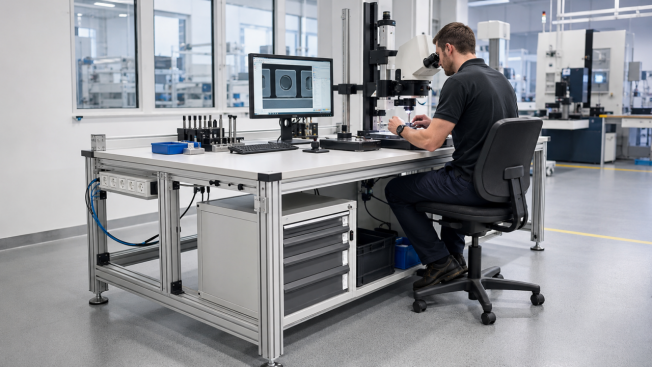
Many workshop managers pay close attention to equipment efficiency, but often overlook human efficiency.
Assembly work often requires employees to perform repeated operations for long periods. If the workbench height is unsuitable, material placement is unreasonable, or tools are too far away, employees will frequently bend over, reach out, turn around, or stand up.
These issues may not be obvious in the short term, but over time they can lead to fatigue, reduced concentration, and even occupational strain in the lower back, shoulders, neck, wrists, and other areas.
The value of an ergonomic workbench is not simply to make employees feel slightly more comfortable. Its real purpose is to make operating movements more reasonable:
Commonly used tools are placed within the natural reach of the arms;
Parts bins are arranged by frequency of use;
The tabletop height is suitable for standing or seated operation;
The lighting angle helps reduce visual fatigue;
Casters, leveling feet, drawers, and pegboards can be flexibly configured according to the process.
When employees no longer need to waste energy looking for items, moving items, or adjusting their posture, work efficiency naturally improves, and assembly errors are easier to reduce.
5. A Good Workbench Is Essentially a Standardized Workstation
A mature assembly workshop does not rely on individual worker experience to maintain order. Instead, it uses standardized workstations to help everyone enter the working state quickly.
A well-designed workbench can help companies achieve:
Fixed tool placement;
Organized material classification;
Neat and safe cable management;
Clear visibility of work documents;
Easier onboarding for new employees;
Faster changeover adjustments;
More unified on-site management.
For companies, this is not simply about buying a few tables. It is about building a more stable, efficient, and repeatable assembly method.
Especially in industries such as automation equipment, electronic assembly, precision manufacturing, and laboratory inspection, the value of workbenches will become increasingly obvious.
Conclusion: Workshop Upgrades Do Not Always Start with Large Equipment
When many companies talk about workshop upgrades, the first things they think of are buying more expensive equipment or implementing more complex systems.
But sometimes, what truly affects on-site efficiency is the basic workstation that is used every day but has long been overlooked.
A suitable industrial aluminum profile workbench can make tools more organized, materials clearer, operations smoother, employees less fatigued, and workshop management more standardized.
From standard assembly to precision assembly, and from ordinary workshops to clean environments, a workbench should never be just a table for placing things.
It should become part of a company’s efforts to improve efficiency, optimize the production site, and enhance the assembly process.
Table of Contents
- 1. The Disorder in Assembly Areas Often Starts with Workstation Layout
- 2. Modular Workbenches Truly Solve the Problem of Difficult Changeovers
- 3. ESD Protection, Cleanliness, and Stability Are Essential for Precision Assembly
- 4. Ergonomics Is Not Just About Comfort, but About Reducing Long-Term Strain
- 5. A Good Workbench Is Essentially a Standardized Workstation
- Conclusion: Workshop Upgrades Do Not Always Start with Large Equipment