EN
Blog Article EN|Aluminum Profile Surface Finishes Compared|Hengdong
Aluminum Profile Surface Finishes Compared: Silver Anodized, Sandblasted, Black Anodized, Frosted & White E-Coating
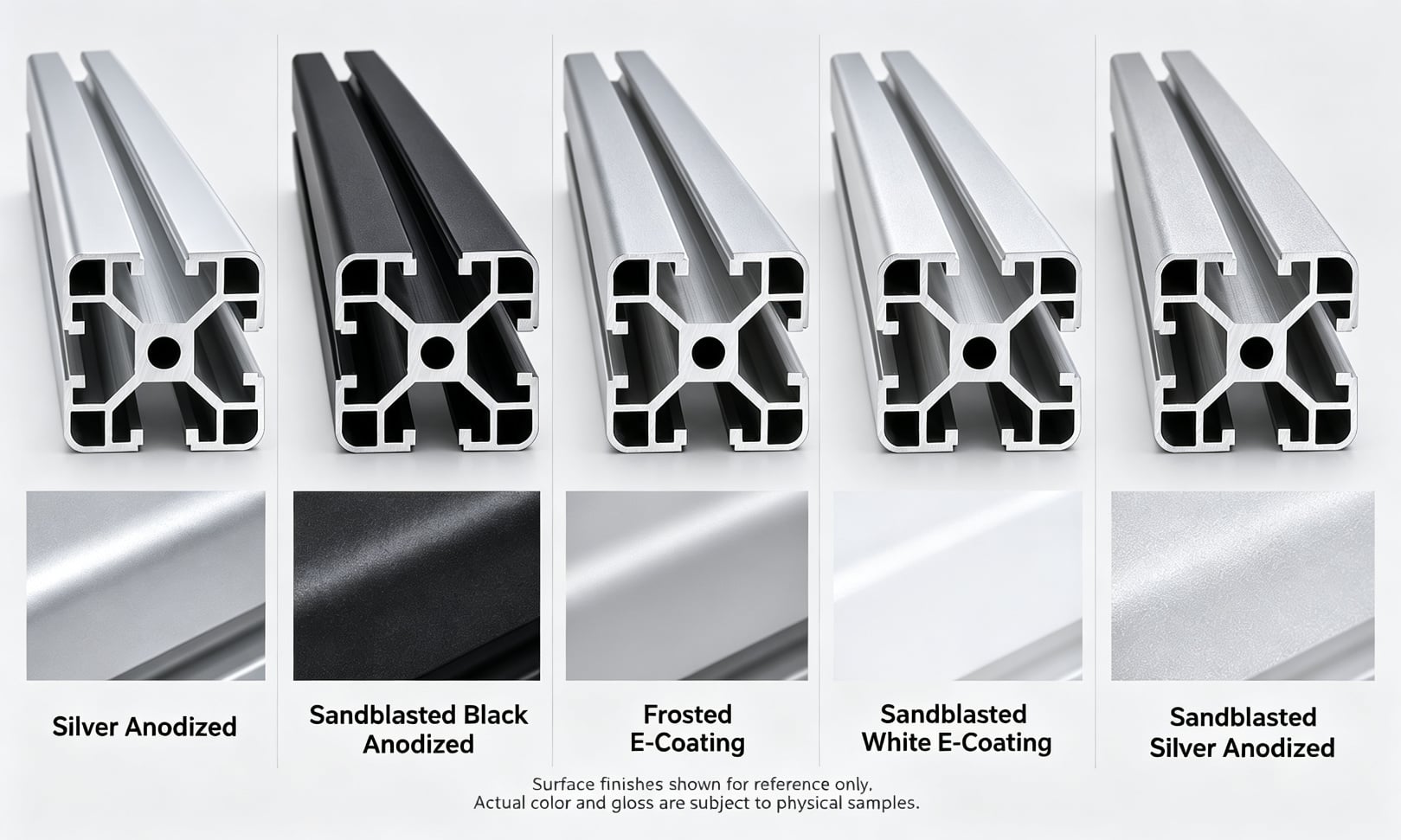
Some aluminum profiles arrive bright and metallic, others are matte, and some are pure white. Telling a supplier “I want silver” or “I want black” is usually not enough — our silver anodized, sandblasted silver anodized and frosted e-coated profiles all look different, are built from different process combinations, and suit different parts of a machine.
This guide explains the five aluminum profile surface finishes Hengdong supplies most often: what each one looks like, where it works best on your equipment, and how to specify it correctly when you request a quote.
1. These 5 finishes are not five mutually exclusive processes
The five finishes we ship most often — silver anodized, sandblasted black anodized, frosted e-coating, sandblasted white e-coating and sandblasted silver anodized — may look like five separate options, but several are actually combinations of two process steps.
A simple way to understand it:
For example:
|
So when requesting a quote, don’t just say “black,” “white” or “matte.” Name the finished surface, tell us where the profile is used on the machine, and state your requirements for color, gloss and appearance consistency. |
Anodizing and e-coating, in plain terms:
|
Item |
Anodizing |
E-coating (electrophoretic coating) |
|
How the film forms |
The aluminum surface itself is converted electrochemically into a hard oxide film |
A smooth, uniform resin film is deposited electrochemically on the surface |
|
Look |
Strong metallic appearance, the aluminum grain shows through |
Smooth, uniform, painted-film look |
|
Common colors |
Silver and black |
A wider color range; white is the most common |
|
Coverage |
Even on exposed faces |
Reaches recesses, grooves and slot details evenly |
|
Surface character |
Hard, wear-resistant film |
Smooth, stain-resistant, easy to wipe clean |
With either process, actual corrosion performance depends on film thickness, sealing quality and the service environment. For outdoor, humid, washdown or chemical-contact environments, let us know up front so the right specification is quoted.
2. The 5 finishes Hengdong supplies most often
2.1 Silver anodized (natural anodizing) — the baseline choice for machine frames
Our most basic and highest-volume finish. The profile is anodized directly without sandblasting, leaving a bright silver metallic surface.
2.2 Sandblasted silver anodized (matte silver) — when you want silver, but softer
Sandblasting first, then silver anodizing — the matte version of silver anodizing.
2.3 Sandblasted black anodized (matte black) — for dark, low-reflection exteriors
Sandblasting followed by black anodizing.
2.4 Frosted e-coating (frosted electrophoretic coating) — fine matte with a smoother surface
A fine frosted texture covered with a clear electrophoretic film, preserving the matte texture while adding a smooth surface layer.
2.5 Sandblasted white e-coating (white electrophoretic coating) — common for white-themed equipment
Sandblasting followed by white electrophoretic coating, which covers the profile evenly in white.
3. The 5 finishes at a glance
|
Finish |
Appearance |
In one line |
Where it is used |
|
Silver anodized |
Bright silver, metallic |
The baseline for standard machine frames |
Frames, conveyor lines, guarding |
|
Sandblasted silver anodized |
Silver matte, fine sandy texture |
Silver, but softer and non-reflective |
Exposed faces, panels |
|
Sandblasted black anodized |
Matte black, low reflection |
For dark, low-reflection exteriors |
Optical / vision equipment, custom frames |
|
Frosted e-coating |
Fine matte, smooth film |
A higher-quality finish for visible parts |
Panels, trim, decorative faces |
|
Sandblasted white e-coating |
White matte, uniform color |
Common for white-themed equipment |
Medical / food / cleanroom equipment, enclosures |
In short: choose by cost for internal structural parts, by color and gloss for visible faces, and confirm a sample for white and dark finishes.
4. How to choose: 3 steps
Step 1 — Start with color. For silver tones, choose silver anodized or sandblasted silver anodized; for dark, choose sandblasted black anodized; for white, choose sandblasted white e-coating.
Step 2 — Choose the gloss. Want bright metallic luster? Go with silver anodized. Soft matte? Sandblasted silver anodized. Matte but smooth and easy to clean? Frosted e-coating.
Step 3 — Consider the location and environment. Internal frames can be selected by cost; visible faces by appearance. For outdoor, humid, washdown or chemical-contact environments, state the conditions when quoting so the correct film specification is offered. Additional steps such as sandblasting, coloring and e-coating affect price and lead time; quotations are based on profile size, quantity and finish requirements.
5. Before you order, specify these 4 things
|
Two common mistakes: ① Sandblasting and frosted treatment are not standalone finishes — “sandblasted” alone cannot be quoted. State whether it is followed by anodizing or e-coating. ② Surface treatment is a finish, not a material change. The same profile can be supplied with different finishes. |
6. Surface finishes from Hengdong Aluminum
Hengdong Aluminum supplies silver anodized, sandblasted silver anodized, sandblasted black anodized, frosted e-coating and sandblasted white e-coating profiles, together with cutting, drilling, tapping and other fabrication services.
Not sure which finish to choose? Send us the application, the part’s position on the machine, and your color and appearance requirements — our team will recommend a suitable surface solution.
Request a quote or order samples to check the finishes in person.
FAQ
What is the difference between anodizing and e-coating on aluminum profiles?
Anodizing converts the aluminum surface itself into a hard oxide film with a strong metallic look; silver and black are the standard colors. E-coating deposits a smooth, uniform resin film after pre-treatment (sometimes over an anodized base), offering a wider color range — white is the most common — and even coverage in recesses and slot details.
Which aluminum profile finish is best for a machine frame?
Bright silver anodizing is the standard choice for internal frames. For visible surfaces, sandblasted silver anodizing or frosted e-coating gives a more uniform, higher-quality look. Choose matte black for optical or vision equipment, and white e-coating for medical, food or cleanroom equipment.
Can I order profiles with “sandblasting” only?
No. Sandblasting is a texture pre-treatment, not a finished surface. It is always followed by anodizing or e-coating to protect the aluminum, so please specify the finished surface, such as “sandblasted silver anodized.”
Do black and white profiles vary between production batches?
Dark and white finishes are more sensitive to batch-to-batch variation. We recommend approving a sample first; production can then follow the agreed reference standard.
Are these finishes suitable for outdoor or washdown environments?
Corrosion resistance depends on film thickness, sealing quality and the actual environment. Share the outdoor, humid, washdown or chemical-contact conditions when requesting a quote, and the correct specification will be offered.