EN
EN
If you regularly follow high-end European equipment, you may notice a clear change:
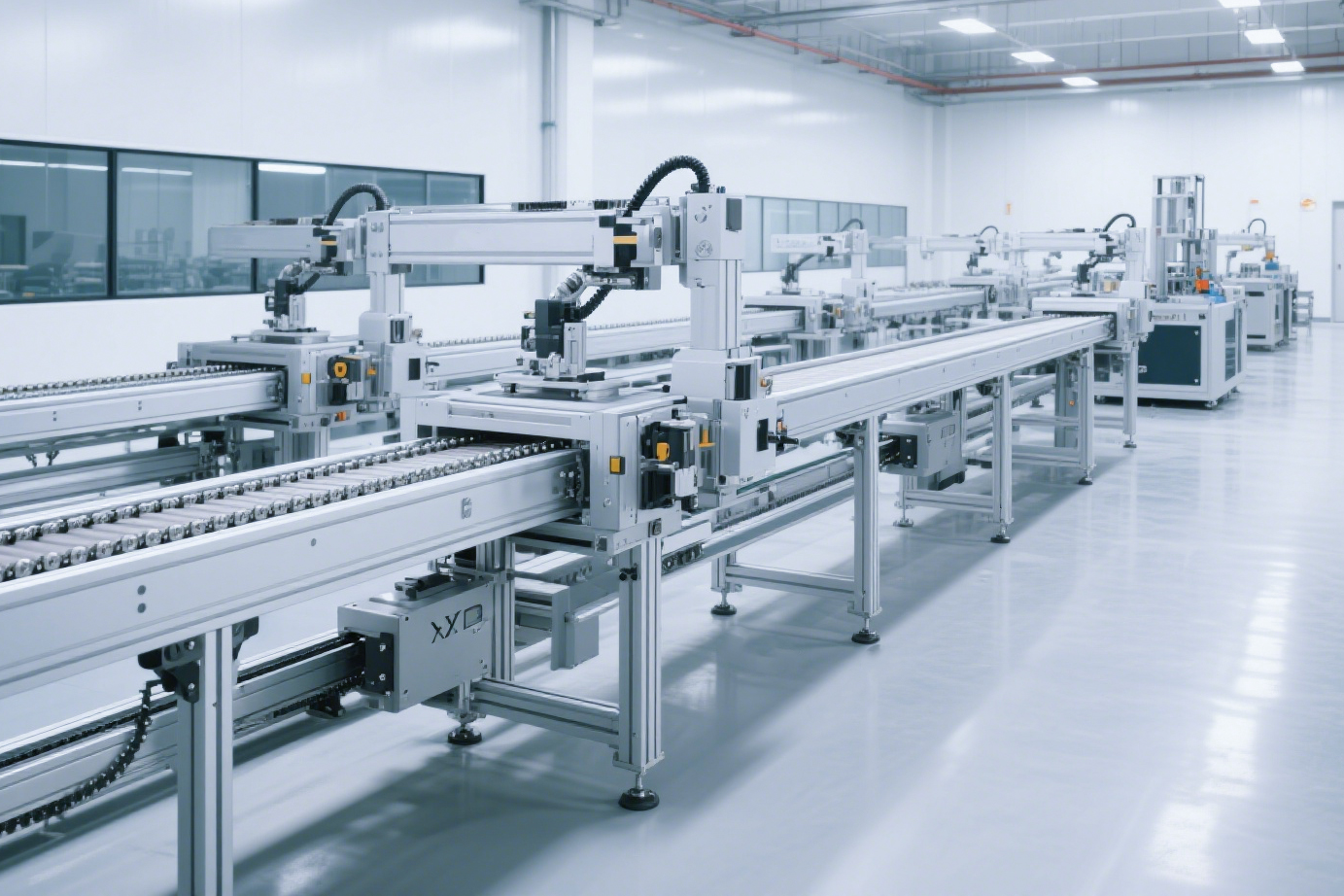
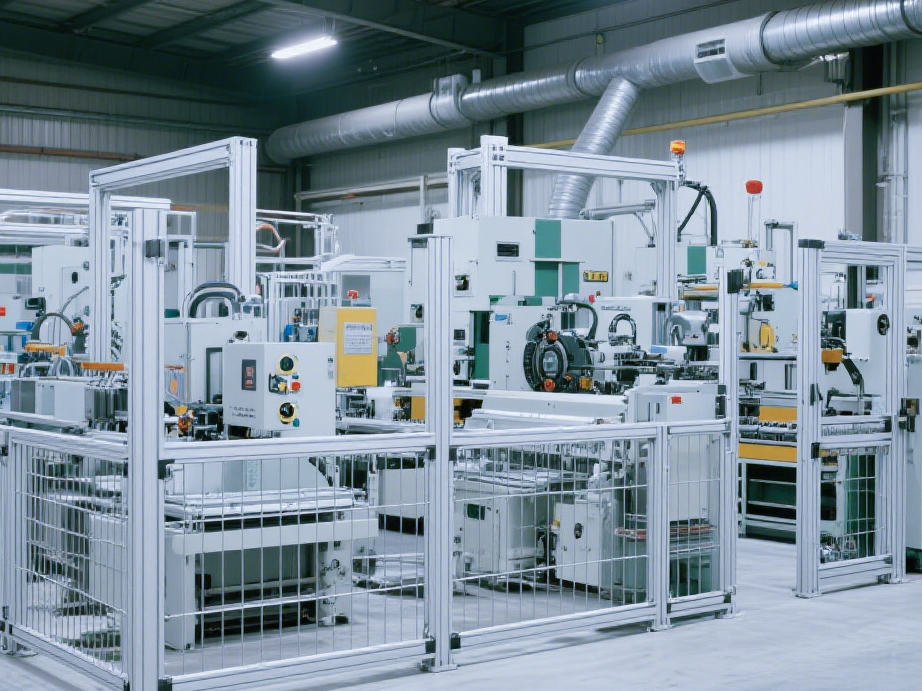
Many machines are no longer built in the traditional form of a “large steel frame + sheet-metal enclosure.” Instead, complete equipment structures are increasingly assembled from aluminum profile frames, transparent guards, standard connectors, and modular units.
This shift is not simply about making equipment look better. Behind it is a broader trend in high-end equipment manufacturing:
Equipment is moving away from standalone-machine manufacturing and toward modular, standardized, maintainable, and upgradeable system-based design.
In this article, we use the COLINES ALLrollEX® cast film production line displayed at Germany’s K Show as an example to discuss why European equipment is increasingly adopting frame-based structures, and what this trend requires from industrial aluminum profiles, connection accessories, and machining support.
1. Why Look at Equipment Trends at Germany’s K Show?
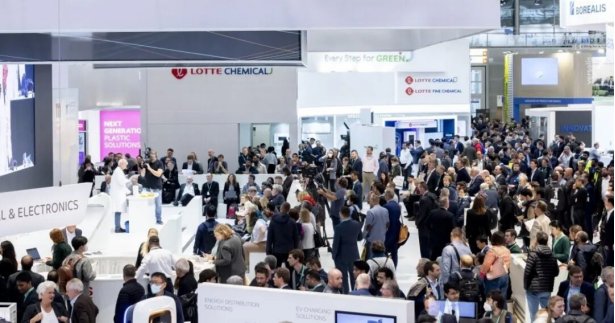
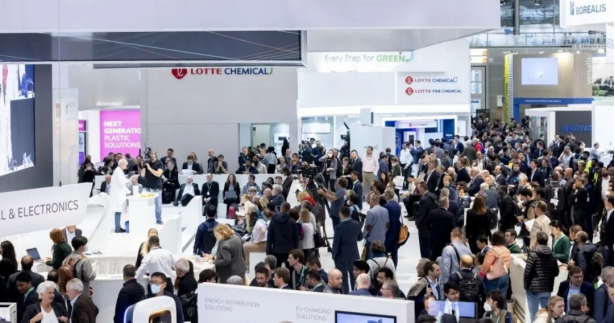
Germany’s K Show, also known simply as K, is one of the most important professional trade fairs in the global plastics and rubber industry. Organized by Messe Düsseldorf, K was first held in 1952 and is usually held every three years. It is a major platform where new technologies in plastics, rubber, packaging, extrusion, injection molding, recycling, automation, and related fields are presented.
Taking the recent K 2025 as an example, the exhibition attracted 3,275 exhibitors from 66 countries and more than 175,000 professional visitors from around 160 countries and regions. Its themes were also very clear: green, smart, and responsible, with a focus on sustainability, digitalization, the circular economy, and high-end manufacturing.
Therefore, when we look at a piece of equipment at K Show, we are not only looking at a single machine. We are also seeing where the entire industry is heading.
For film production lines, packaging equipment, and extrusion equipment, the machines displayed at K Show are often representative products of equipment manufacturers. They demonstrate not only core process technology, but also safety guarding, modular structures, automation control, energy-saving design, and the overall appearance of the complete machine.
2. Why Is Film Equipment Worth Attention?
Behind this type of equipment is a very large market: plastic films and flexible packaging.
According to data released by Plastics Europe, global plastics production in 2023 was approximately 413.8 million tonnes. Among these materials, PP accounted for 19.0%, PE-LD/PE-LLD for 14.0%, and PE-HD/PE-MD for 12.2%. These materials are closely related to applications such as films, packaging, containers, pipes, and industrial products.
From the perspective of the packaging market, flexible packaging remains one of the faster-growing segments. Grand View Research estimates that the global flexible packaging market was about USD 293.92 billion in 2025 and is expected to reach USD 440.88 billion by 2033, with a compound annual growth rate of around 5.3% from 2026 to 2033. Among these, plastic materials accounted for more than 69% of flexible packaging market revenue in 2025.
What does this mean?
It means that equipment for film production, packaging, winding, inspection, and automation control is not a niche industry. It is part of the basic equipment that supports global consumer goods, food, pharmaceuticals, e-commerce, and industrial packaging.
As long as the packaging industry continues to grow, film production lines, packaging equipment, inspection equipment, conveying equipment, and automation support systems will continue to be upgraded.
3. Case Study: COLINES ALLrollEX® Cast Film Production Line
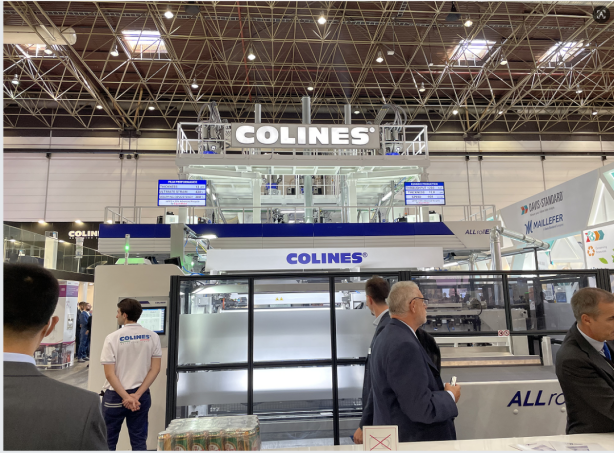
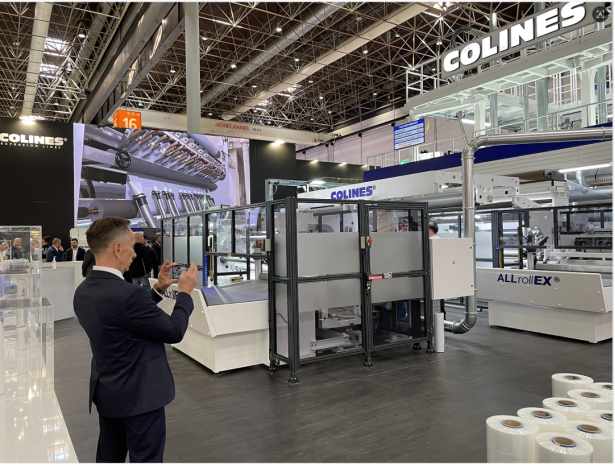
At Germany’s K Show, the ALLrollEX® cast film production line displayed by the Italian company COLINES was a typical example of high-end film extrusion equipment.
A cast film production line is mainly used to produce stretch film, packaging film, multilayer co-extruded film, and similar products. Its basic process can be understood in simple terms as follows:
Plastic raw materials are heated and melted through the extrusion system, formed into film through a die, rapidly set by cooling rollers, and then passed through traction, inspection, winding, and other processes before finally becoming roll-shaped film products.
A complete cast film production line is usually not a single machine. Instead, it is composed of multiple functional units:
extrusion unit, die unit, cooling and setting unit, traction unit, winding unit, safety guarding system, and electrical control and inspection system.
These modules must work together continuously while also remaining convenient for installation, commissioning, maintenance, and later upgrades.
Therefore, what truly tests high-end equipment is not only the core process technology, but also the ability to organize the entire equipment structure.
4. Why Are Frame-Based Structures More Suitable for Modular Equipment?
Modern industrial equipment is less and less likely to be a “single machine.” More often, it is a complete production line made up of multiple functional modules.
Taking a cast film production line as an example, extrusion, die, cooling, traction, winding, electrical control, and guarding each have their own functional boundaries. Equipment manufacturers need to organize these modules within one system so that they can be assembled independently while operating in coordination.
At this point, the advantages of a frame-based structure become very clear.
Compared with traditional welded structures, aluminum profile frames are easier to divide and design according to functional areas. Each module can form a relatively independent structural unit, and then these units can be combined into a complete machine through connectors, support components, and standard accessories.
Its value is mainly reflected in four aspects:
First, installation is faster.
Modules can be machined and preassembled in advance, then combined on site, reducing the need for on-site welding, grinding, painting, and other processes.
Second, adjustment is more flexible.
If sensors, door panels, guards, support components, or local functional modules need to be added later, the aluminum profile frame can be adjusted through disassembly and reconnection.
Third, maintenance is easier.
When a problem occurs, maintenance can be performed on a specific module instead of requiring large-scale disassembly of the whole machine structure.
Fourth, it is better suited to customized projects.
Many automation machines, packaging machines, and conveying systems are not completely standard products. They are designed according to the customer’s site conditions and process requirements. Frame-based structures are naturally better suited to this project model of “designing, adjusting, and optimizing at the same time.”
Therefore, the growing emphasis on frame-based structures in European equipment is not essentially because one particular material has become fashionable. It is because the way equipment is manufactured is changing.
5. Safety Guarding Is No Longer an “Add-On”
Many people see the transparent guards around equipment and assume that they are only for dust prevention or appearance.
However, in high-end equipment, safety guarding itself is part of the complete machine system.
For equipment such as cast film production lines, there are high-speed rollers, traction mechanisms, winding mechanisms, transmission systems, and heating components inside the machine. Without a reasonable guarding structure, accidental human contact, foreign objects entering the machine, or incorrect operation during maintenance can all create risks.
A frame-based guarding system is usually composed of aluminum profile frames, transparent panels, door locks, hinges, handles, limit switches, sensors, emergency stop buttons, and other components.
It needs to meet several requirements at the same time:
It must isolate hazardous areas while allowing operators to observe the equipment’s operating status.
It must be convenient to open for maintenance while also allowing the installation of door locks, sensors, alarm lights, and other accessories.
It must ensure safety without affecting the efficiency of equipment commissioning and maintenance.
Therefore, a guarding structure is not simply something that “surrounds” the equipment. It is an integrated structural system that combines safety, observation, maintenance, and control.
This is also why many European machines use black aluminum profile frames together with transparent protective panels. This design is not only visually consistent; it also reflects a clear safety logic.
6. Equipment Appearance Is Becoming Part of Quality Judgment
In the past, many people evaluated a machine mainly by whether it could run, how efficient it was, and whether it was stable.
In the high-end equipment market, however, customers now judge machines by more than these factors.
When a machine is displayed at a trade show, the first thing customers see is its external structure:
Are the lines neat?
Is the guarding complete?
Are the modules clear?
Is the electrical control layout standardized?
Does the whole machine have an industrial and international quality feel?
European equipment often gives people the impression of being clean, orderly, and well organized.
Behind this impression, in addition to sheet-metal enclosures and control systems, is the standardization of frame structures.
Aluminum profile frames have several natural advantages:
The surface treatment is consistent, making the visual appearance cleaner.
The strong linear form suits modern industrial equipment.
The accessory system is mature, making assembly more standardized.
They can be well integrated with transparent panels, sheet-metal parts, and electrical components.
Later adjustments do not require major rework as welded structures often do.
Therefore, a frame structure is not only a functional component. It is also part of the equipment brand image.
For high-end equipment manufacturers, what the customer sees is not a single profile, but the professionalism conveyed by the complete machine.
7. The Growth of Automation Is Also Driving the Popularity of Frame-Based Structures
The spread of frame-based structures is also closely related to the global trend toward automation.
According to MarketsandMarkets, the global industrial control and factory automation market is expected to grow from USD 274.99 billion in 2025 to USD 435.24 billion in 2030, with a compound annual growth rate of approximately 9.6% from 2025 to 2030. This shows that manufacturing investment in automation control, robots, inspection systems, and smart production lines is still increasing.
Data from the International Federation of Robotics also shows that around 542,000 industrial robots were newly installed worldwide in 2024. This figure exceeded 500,000 units for the fourth consecutive year and was more than double the level of a decade earlier.
The more automation equipment there is, the more modular equipment structures need to become.
This is because an automation system is not a single component. It is composed of mechanical structures, electrical control systems, sensors, actuators, guarding systems, conveying systems, and more. Every additional functional module requires more support frames, guarding structures, mounting platforms, and connection accessories.
This is also why aluminum profile frames are becoming increasingly common.
In essence, they serve as the “structural interface” inside automation equipment.
8. Behind Frame Structures, the Real Test Is Supply Chain Support Capability
From the outside, an equipment frame may look like only a few profiles and panels.
But when it comes to real implementation, it is not that simple.
A complete equipment frame often involves many details:
Which profile specifications should be selected?
Does the load-bearing area need reinforcement?
How should the door panels be positioned?
What mounting method should be used for transparent panels?
How should hinges, door locks, and handles be matched?
Where are holes required?
Where is tapping required?
Where are counterbores required?
How should the on-site assembly sequence be arranged?
If these details are not properly prepared in the early stage, they can affect the equipment manufacturer’s assembly efficiency and even the delivery schedule of the complete machine.
Therefore, when high-end equipment manufacturers choose an industrial aluminum profile supplier, they often look not only at the price of a single profile, but also at the supplier’s overall support capability.
This is where Hengdong Aluminum Co., Ltd. can play a role in such equipment structures.
Hengdong Aluminum is more like a structural-component support supplier behind equipment manufacturers. Focusing on application scenarios such as automation equipment, packaging equipment, conveying equipment, and film equipment, Hengdong provides customers with industrial aluminum profiles, connection accessories, and machining support such as cutting, drilling, and tapping.
This support capability can help equipment manufacturers reduce fragmented procurement and secondary processing, allowing profiles and accessories to enter the assembly stage faster.
It should be noted that the value here is not to exaggerate the claim that “we manufacture complete machines.” Instead, the value lies in building a reliable structural-component supply chain: making the profiles, accessories, machining, and frame support required by equipment manufacturers more stable and more efficient.
9. Which Types of Equipment Are Suitable for Aluminum Profile Frame Structures?
Aluminum profile frames are not suitable for every situation, but their advantages are very clear in the following scenarios:
automation equipment frames;
equipment safety guarding fences;
peripheral structures for packaging equipment;
conveyor line frames;
inspection equipment supports;
electronic assembly equipment frames;
auxiliary structures for new-energy equipment;
laboratory equipment platforms;
robot workcell fences;
modular support structures for non-standard equipment.
These types of equipment have common characteristics:
The structure needs to be adjustable, modules need to be combined, later maintenance is required, and the appearance also needs to remain clean and orderly.
In other words, as long as equipment needs to be installable, adjustable, maintainable, and upgradeable, frame-based structures have application value.
10. Future Trends Seen Through European Equipment
From equipment such as the COLINES ALLrollEX® cast film production line, we can see several changes taking place in high-end equipment manufacturing.
First, equipment is becoming increasingly modular.
A machine is no longer just one whole unit, but a combination of multiple functional units.
Second, safety guarding is becoming increasingly system-based.
Guarding structures are no longer added later. They need to be considered from the design stage.
Third, appearance is becoming increasingly important.
Equipment must not only work; it must also reflect the brand image and manufacturing level of the supplier.
Fourth, delivery efficiency is becoming increasingly critical.
Customers want equipment that can be installed faster, commissioned faster, and maintained more conveniently.
Fifth, supply chain support is becoming increasingly professional.
Profiles, connectors, machining services, protective panels, and installation accessories all need to work together more completely.
This is why industrial aluminum profile frames are becoming increasingly common in high-end equipment.
What they represent is not just one material, but a more flexible structural design approach that is better suited to modern manufacturing.
Conclusion
The COLINES ALLrollEX® cast film production line at Germany’s K Show shows that high-end European equipment is placing increasing emphasis on the use of frame-based structures.
This type of structure not only makes equipment cleaner and more visually refined. More importantly, it improves the equipment’s modularity, safety guarding capability, maintenance convenience, and delivery efficiency.
For equipment manufacturers, a frame-based structure is not simply an “enclosure” or a “fence.” It is part of the engineering design of the complete machine.
Behind these structures, stable support from industrial aluminum profiles, connection accessories, and machining services is also becoming an important link in the equipment manufacturing supply chain.
Hengdong Aluminum Co., Ltd. will continue to focus on application scenarios such as automation equipment, packaging equipment, conveying equipment, and film equipment, providing customers with industrial aluminum profiles and frame-structure support to help equipment manufacturers improve assembly efficiency and overall machine quality.
References
K Show / Messe Düsseldorf exhibition materials; Plastics Europe, Plastics – the Fast Facts 2024; Grand View Research flexible packaging market data; MarketsandMarkets industrial control and factory automation market data; and relevant statistics from the International Federation of Robotics, World Robotics 2025.
Table of Contents
- 1. Why Look at Equipment Trends at Germany’s K Show?
- 2. Why Is Film Equipment Worth Attention?
- 3. Case Study: COLINES ALLrollEX® Cast Film Production Line
- 4. Why Are Frame-Based Structures More Suitable for Modular Equipment?
- 5. Safety Guarding Is No Longer an “Add-On”
- 6. Equipment Appearance Is Becoming Part of Quality Judgment
- 7. The Growth of Automation Is Also Driving the Popularity of Frame-Based Structures
- 8. Behind Frame Structures, the Real Test Is Supply Chain Support Capability
- 9. Which Types of Equipment Are Suitable for Aluminum Profile Frame Structures?
- 10. Future Trends Seen Through European Equipment
- Conclusion
- References