EN
EN

HENTON NEW PRODUCT · PRODUCT LAUNCH
New Product | Henton 08BS Single-Speed Chain Drive and Tail Units
A More Modular Approach to Drive, Return and Tensioning for Pallet Conveyors
Conveyor Drive Unit · Modular Tensioning Unit · Integrated Head and Tail Assemblies
Dongguan Henton Aluminum Co., Ltd. | New Product Article
In automated assembly, inspection, buffering and material-transfer processes, a conveyor may appear to do little more than move a product from one station to the next. In practice, however, the parts that most strongly influence long-term stability are often not the highly visible aluminum-profile frame, but the drive, return and tensioning mechanisms located at the two ends of the conveyor.
Stable power delivery at the drive end, correct engagement between the sprockets and chain, synchronization of the two chain strands, and the ability of the tail end to compensate for chain elongation all directly affect noise, vibration, tooth skipping, mistracking, accumulation stability and maintenance costs. In an 08BS single-speed pallet conveyor, the head and tail units are therefore much more than two mounting blocks: they are the critical end nodes that close the conveyor's power-transmission loop.
To meet the demand from automation equipment manufacturers, custom-machine integrators and end users for modular conveyor components, Dongguan Henton Aluminum Co., Ltd. has introduced its 08BS single-speed chain drive and tail assemblies. The range covers the conveyor drive housing, head drive module, tail return module and modular tensioning unit, helping customers reduce the work involved in designing from scratch, sourcing parts separately, repeatedly checking compatibility and commissioning on site. The result is a more efficient way to build or upgrade an 08BS pallet conveyor.
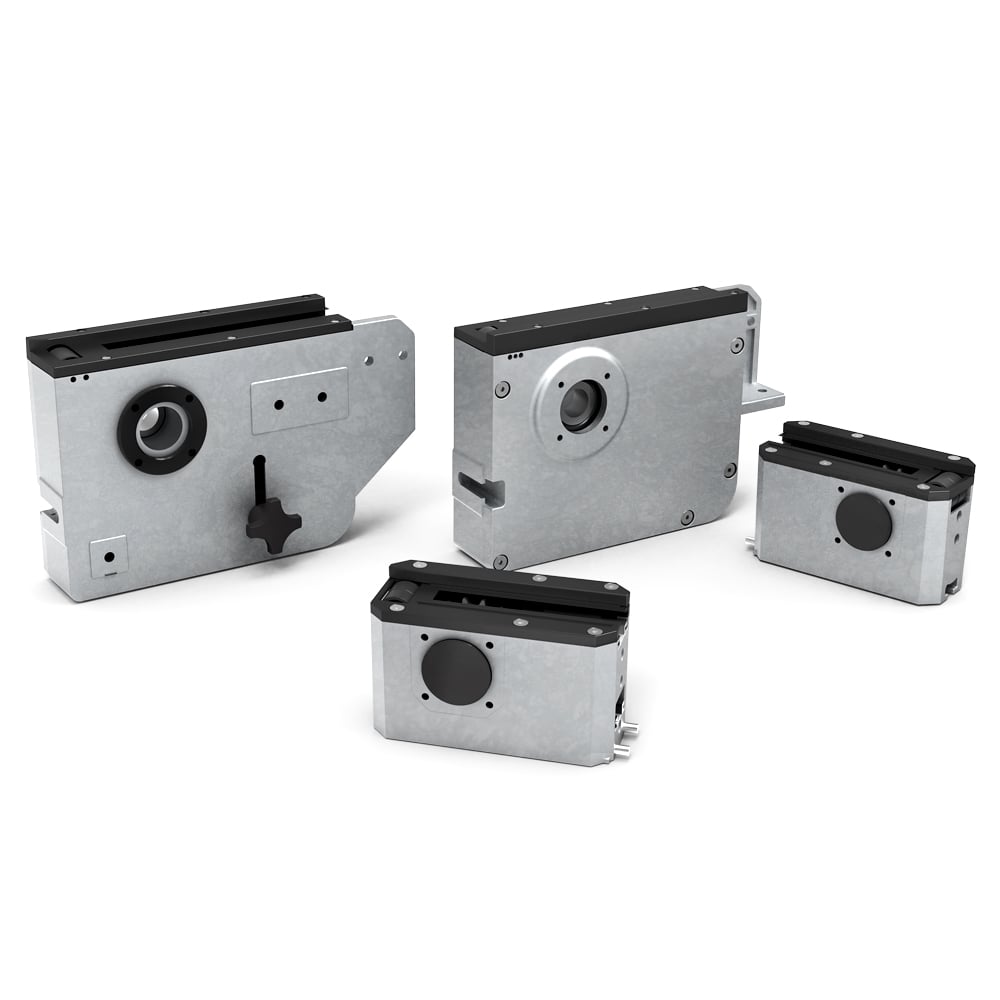 [ 08BS single-speed chain drive and tail units on a white background]
08BS is a roller conveyor chain specification widely used for pallet transport, workpiece-carrier transport and in-process logistics on assembly lines. Unlike a conventional power-transmission chain, whose main job is to transmit torque, an 08BS large-roller chain can provide traction while also supporting or driving the pallet above it. Workpiece carriers, fixtures and products can therefore move steadily along the conveyor section.
According to commonly available industry data for 08BS-27 large-roller chain, the base chain typically has a 12.7 mm pitch, a 27 mm large-roller diameter, an inner width of approximately 7.75 mm and a pin diameter of approximately 4.45 mm. The large rollers may be supplied in engineering plastic or steel, depending on the application. These values are common industry reference dimensions only. Every project should still be checked against the exact chain, sprocket and approved drawing being used; the designation “08BS” by itself is not a substitute for an assembly and interface review.
The term “single-speed” does not mean inefficient or suitable only for very slow operation. It distinguishes this arrangement from 2.5-times and 3-times speed-chain systems. With a single-speed chain, pallet travel is much closer to the chain's linear speed, so the motion relationship is direct and predictable. This configuration is well suited to applications that prioritize load capacity, smooth travel, compatibility with pallet accumulation and mechanical reliability. Publicly documented applications include automotive component assembly conveyors, heavy-duty pallet lines and modular workpiece-carrier systems.
When the production cycle requires buffering, a stop unit can hold a pallet at a defined station while the chain or roller mechanism continues to run. Once the stop is released, the pallet proceeds to the next operation. By adding lift-and-locate units, transfer mechanisms, lifts, turntables, sensors and a control system, the conveyor can become a complete automation platform with accumulation, positioning, line transfer, pallet return and automatic loading or unloading functions.
A complete 08BS chain conveyor normally includes a geared motor, drive shaft, sprockets, drive head, driven or tensioning tail unit, conveyor chains, guide rails or wear strips, aluminum-profile frame, pallets, stop units and an electrical control system. The chain creates the continuous conveying loop, but the head and tail assemblies are what introduce power, maintain the correct chain path and control chain tension.
The drive end transfers torque from the geared motor to the drive shaft, which rotates the sprockets on both sides in synchronization. As the sprocket teeth engage the chain, the two chain strands circulate along their tracks and move the pallets forward. Bore and keyway dimensions, shaft-to-hub fit, sprocket alignment, bearing support rigidity and mounting datums all influence transmission stability during this process.
The tail end primarily turns the chain back, guides it and provides tension adjustment. During long-term operation, normal wear at the pins, bushings and engagement surfaces can gradually increase the effective chain pitch. Temperature variation, changing loads and installation tolerances can also alter chain tension. A chain that is too loose may vibrate, skip teeth, generate impact and become noisy; a chain that is too tight adds unnecessary load to the chain, sprockets and bearings and accelerates wear. A stable and accessible tensioning tail unit is therefore essential to sustained reliability.
Industry troubleshooting guidance repeatedly identifies sprocket misalignment, improper tension, insufficient lubrication, mismatched sprockets and chains, and component wear as common causes of noise, tooth skipping, vibration and jamming. This is where modular head and tail assemblies create practical value. Integrating the sprockets, bearing supports, mounting datums, protective housing and tensioning structure into standardized modules reduces errors caused by improvised on-site fabrication and gives designers, assemblers and maintenance teams a clearer mechanical baseline.
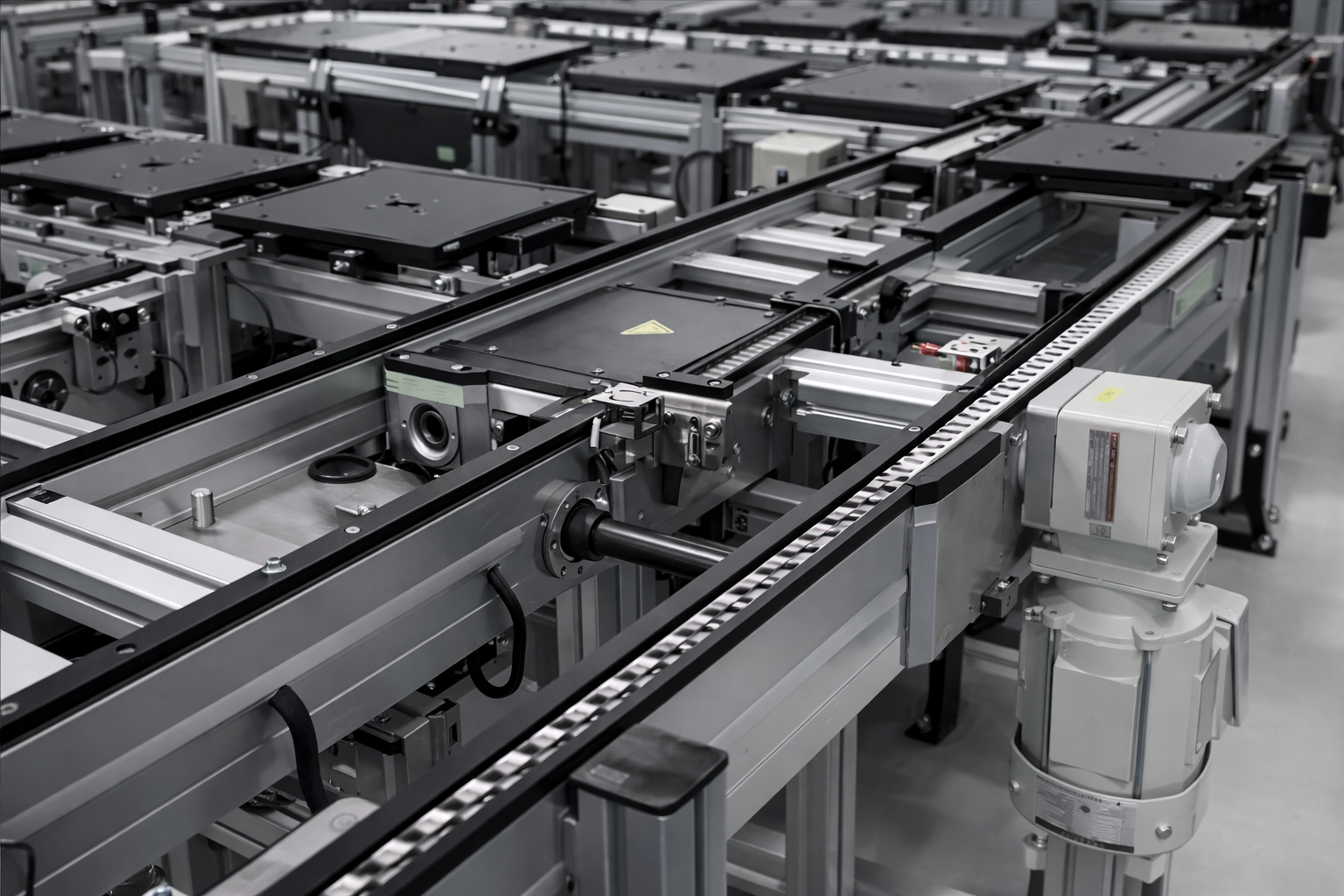
Henton's new 08BS single-speed chain drive and tail units are designed for pallet conveyors using 08BS roller chain. The product page presents an integrated set of head and tail components. The drive module provides the power input and sprocket drive, while the tail module returns, guides and tensions the chain. The assemblies can be used in automated assembly lines, workpiece-carrier conveyors, pallet circulation systems and related custom conveyor equipment.
Based on information currently shown on the product page, the main assembly combines aluminum-alloy and carbon-steel components and incorporates ground-finished surfaces. Aluminum alloy helps reduce module weight, creates a clean industrial appearance and integrates naturally with aluminum-profile conveyor frames. Carbon steel is used where transmission, support or localized mechanical loading requires greater strength. The two materials are assigned according to function: housings and mounting blocks emphasize modularity and ease of assembly, while shafts, sprockets and other load-bearing parts emphasize rigidity, wear resistance and dependable power transmission.
The drive-head configuration displayed on the product page has a 25 mm round bore and an 8 mm keyway for connection to a matching drive shaft and transmission arrangement. A keyed joint transmits torque between the shaft and hub and is well suited to the continuous-duty conditions common in automated conveyors. Because motor power, gear ratio, conveying speed, total load, shaft diameter and installation space vary from one line to another, customers should confirm the bore, keyway, chain specification, sprocket type and mounting datums before ordering rather than matching the unit by appearance alone.
The modules use a relatively enclosed, orderly outer form that groups the internal transmission and support parts into a compact assembly. This minimizes exposed structure and helps the head and tail units form a cohesive, professional machine appearance with an aluminum-profile conveyor. The modular layout also supports repeat equipment builds: when the same conveyor design is replicated across several production lines, common interfaces, mounting datums and spare-part logic reduce repetitive engineering and simplify long-term maintenance.
When a conventional custom conveyor head and tail are designed from individual parts, the builder often has to purchase bearings, sprockets, shafts, mounting plates, guards, tensioning blocks and fasteners separately, then redraw the assembly for the selected profile section and pallet width. A fragmented supply chain increases engineering work and can create inconsistencies in hole positions, shaft height, chain-line location or guarding during assembly.
Henton supplies the essential drive-end and tail-end functions as coordinated modules, allowing equipment manufacturers to complete the surrounding conveyor design around defined interfaces. For replicated assembly, inspection and pallet-return lines, this approach can shorten BOM preparation, purchasing coordination and on-site matching time.
An all-steel structure can provide high rigidity, but it is heavy and less flexible in appearance and later modification. An all-aluminum design may not be appropriate for sprockets, shafts and highly loaded areas. Combining aluminum alloy with carbon steel assigns each material to the role it performs best: the module remains clean, comparatively lightweight and easy to install while critical transmission locations retain the mechanical properties they require.
Modern automated conveyors frequently use industrial aluminum profiles because their standardized slots support flexible connections and easy installation of sensors and accessories. They also allow later expansion or line modification without extensive welding. Henton has extensive experience in industrial aluminum profiles and conveyor components and can coordinate drive and tail assemblies with conveyor profiles, guide rails, wear strips, legs and connectors, so the end module becomes an integrated part of the line rather than an isolated component that is difficult to incorporate.
A chain conveyor does not remain permanently maintenance-free after initial installation. A new chain may elongate slightly during its running-in period, while long accumulation zones, frequent starts and stops, and load variation can change its operating condition. A modular tensioning unit provides a clear adjustment point. Maintenance personnel can evaluate operating sound, chain sag, sprocket engagement and the machine instructions, then correct the tension before excessive looseness or tightness develops into a failure.
The head and tail areas contain rotating shafts, sprockets and the chain return path, making them both maintenance points and areas that require careful guarding. An orderly modular housing supports a compact layout and makes it easier to plan guards, inspection access and safety labels consistently. If the chain, sprockets or bearings require service, technicians can inspect and remove the relevant module without dismantling a large portion of the conveyor.
For automation equipment manufacturers, the value of a module is not merely that it can be installed after purchase. More importantly, it becomes a reusable design unit. Standard machines can call on a proven assembly to shorten mechanical design cycles. Custom projects can then be checked around pallet width, chain-line center distance, drive-shaft interface, motor arrangement, installation direction and available space, preserving project flexibility on top of a standardized foundation.
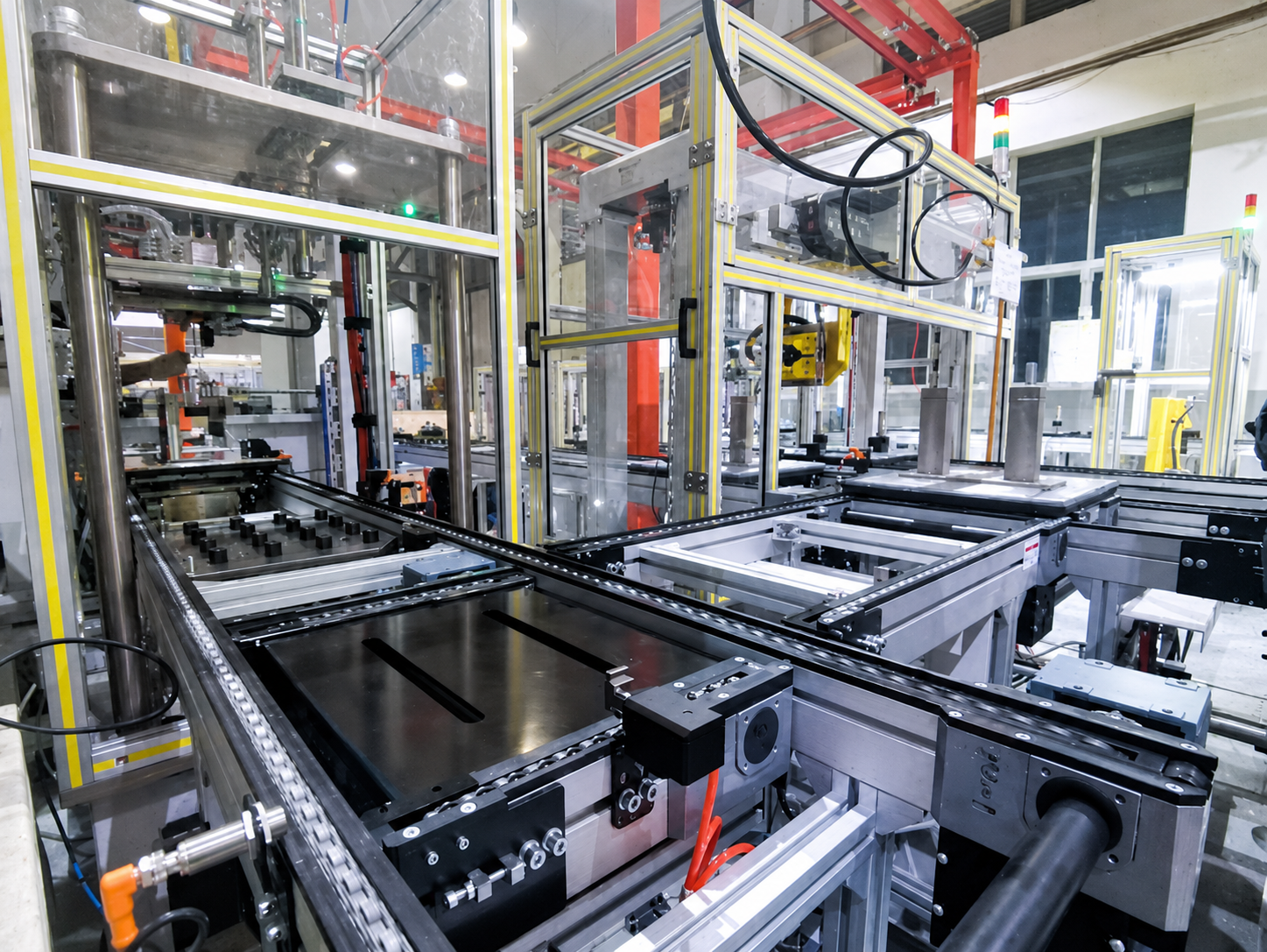
Henton 08BS single-speed chain drive and tail units can be used in many automated conveying applications in which pallets, workpiece carriers or fixtures transport the product.
On automotive component assembly lines, parts are often comparatively heavy and pass through multiple operations such as assembly, fastening, testing, code scanning and unloading. An 08BS single-speed chain can convey pallets along straight sections, while stop units create controlled buffers between stations. Lift-and-locate devices or robots can then perform accurate operations on the positioned workpiece.
In the manufacture of new-energy batteries, electric motors and gearboxes, pallets often carry components that have both meaningful weight and specific positioning requirements. Modular drive and tail assemblies can be combined with aluminum-profile frames, pallets, locating pins, lifting mechanisms and sensors to create automated conveyor cells with a clearly controlled production cycle.
In appliances, hardware, electronics assembly and general industrial manufacturing, an 08BS pallet conveyor can handle work-in-process transfer, in-line assembly, functional testing, aging buffers and pre-packaging transport. On flexible production lines with several product variants, interchangeable fixtures can be mounted on the pallets so that one conveyor can accommodate different workpieces.
For warehouse and line-side logistics, a pallet conveyor can interface with lifts, transfer units, turntables, roller conveyors and robots to load parts onto the line, transfer them between levels, change their direction, return empty pallets and unload finished products. As the power and tensioning foundation for each straight conveyor section, modular head and tail units make it easier to divide a complex system into well-defined standard cells.
A stable conveyor cannot be engineered by evaluating one component in isolation. The complete design must account for load, speed, takt time, accumulation length and maintenance access. A practical configuration process normally follows the logic below.
First, define the conveyed load. Confirm the weight of each workpiece, pallet weight, pallet dimensions, center-of-gravity location, underside material and whether accumulation is permitted. The contact between the pallet underside and the chain rollers or wear strips affects rolling resistance, accumulation friction and service life.
Second, define the conveyor parameters. These include effective conveying length, pallet width, conveyor height, running speed, the number of pallets accumulated at one time, maximum total load and leg spacing. Public selection literature for complete 08BS pallet conveyors shows example configurations with maximum speeds up to 20 m/min and conveyor lengths of approximately 10 m. Permissible accumulated load varies with the specific conveyor design, chain-roller material and wear-strip arrangement. These industry figures are provided only to explain typical system-level possibilities; they are not rated values for Henton's head and tail units. Every project must be recalculated using the selected motor, gearbox, sprockets, shaft, bearings, conveyor resistance and design safety factor.
Third, match the drive system. Select geared-motor power and reduction ratio from the required chain speed, full-load starting resistance, accumulation resistance and transmission efficiency. Confirm the motor side, output direction, coupling method and variable-frequency speed range at the same time. A larger motor is not automatically better: undersizing can cause difficult starts and overload, while excessive power can transmit a more severe impact to the chain and structure if the conveyor jams.
Fourth, verify the drive interfaces. The drive-shaft diameter, bore, keyway, sprocket tooth count, distance between the two sprockets, bearing positions and profile mounting holes must be mutually compatible. The 25 mm round bore and 8 mm keyway displayed on the current product page are confirmed interface dimensions and should be included when checking the shaft, coupling or gearbox connection.
Fifth, configure the functional modules. Use stop units when the line requires station dwell and cycle control; add lift-and-locate mechanisms where operations require accurate positioning; use transfer units or turntables for 90-degree direction changes or parallel line transfers; adopt a two-level return or loop layout when empty pallets must circulate; and combine sensors, barcode readers, RFID and PLC controls when process traceability is required.
To improve quotation accuracy and technical confirmation efficiency, customers should provide as much of the following information as possible when enquiring about Henton 08BS single-speed chain drive and tail units:
The more complete the information, the easier it is to determine whether a standard assembly can be used directly and which interfaces require adjustment. For an existing-equipment retrofit, photographs of the conveyor, critical installation dimensions and the current chain and sprocket designations are recommended. For a new project, customers can provide pallet drawings, takt-time requirements and a line layout so that both parties can confirm compatibility at the system level.
During installation, first check the mounting datums at the drive and tail ends and ensure that the two sprockets have appropriate coaxial alignment. The center distance between the left and right chain lines must match the guide rails, conveyor profiles and pallet so that the chains are not continuously forced sideways in operation. After connecting the chain, set the tension according to the equipment design, then rotate the system manually or conduct a low-speed no-load trial to verify smooth return travel without obvious tight spots or abnormal rubbing.
Once no-load operation is normal, proceed gradually through single-pallet, partial-load and full-load tests. Observe whether starting, stopping, accumulation and release are smooth. If a periodic abnormal sound appears, check for sprocket eccentricity, stiff chain links, incorrect connecting-link orientation, a chain-to-sprocket mismatch, wear-strip joints and foreign-object interference. If the chain skips teeth or vibrates, first inspect tension, sprocket alignment and whether the applied load exceeds the design range.
Routine maintenance should include removing dust, chips and oil around the head and tail units and inspecting fasteners, bearings, sprockets, chains and wear strips for wear. Lubrication method and interval must be selected for the actual chain material, speed, environment and chain manufacturer's instructions; more oil is not necessarily better. In applications with engineering-plastic rollers, clean production requirements or airborne dust, unsuitable lubrication can contaminate both pallets and guide tracks.
Adequate service access and guarding must also be retained. Operators must never contact rotating shafts, sprockets or the chain return zone while the equipment is running. Before tensioning, inspection or component replacement, the machine must be stopped, isolated from its power source and secured against unexpected restart in accordance with the site's safety procedures.
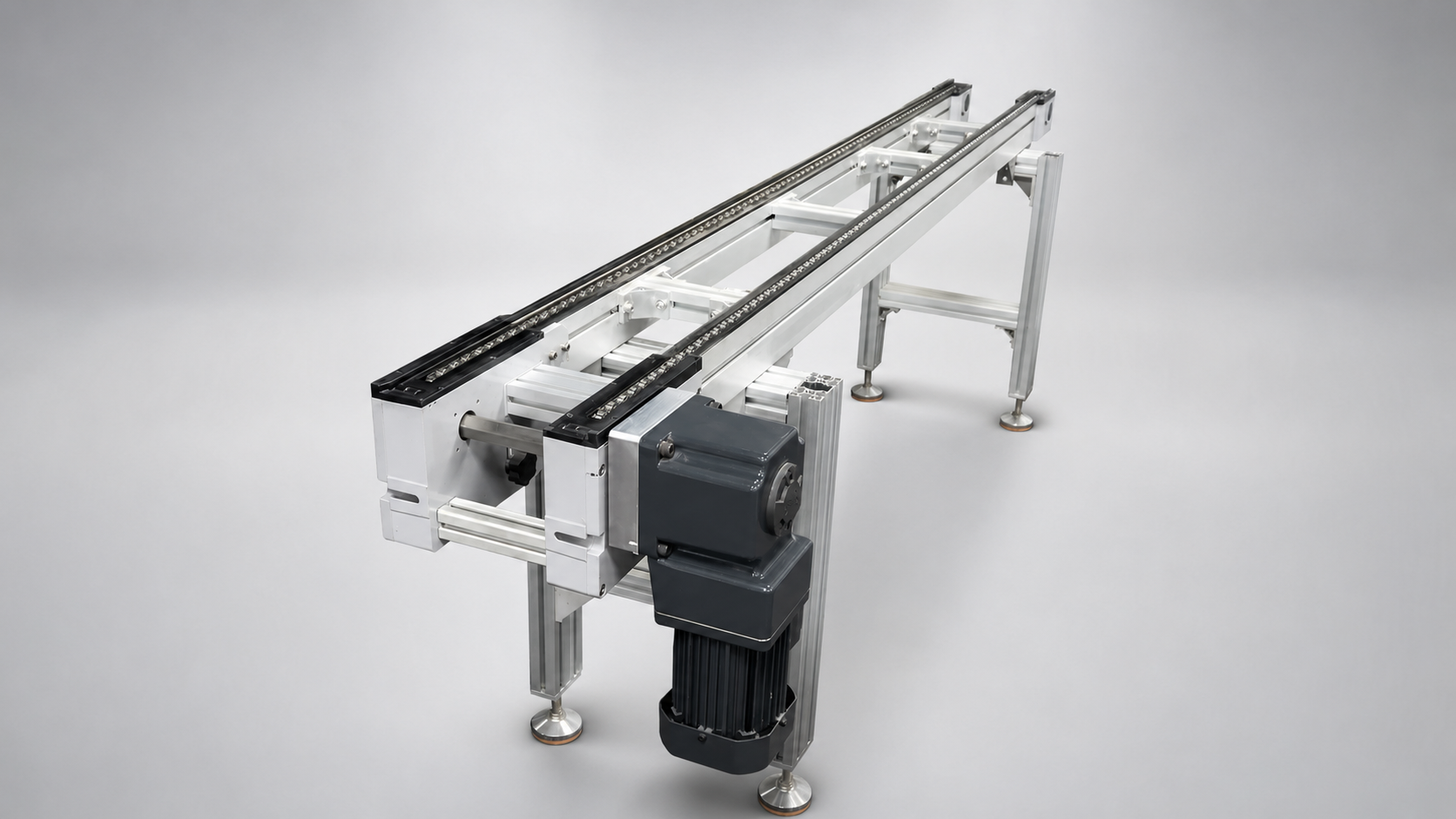
In addition to the newly introduced 08BS single-speed chain drive and tail units, Henton manufactures and supplies industrial aluminum profiles, conveyor profiles, automation frames, guide components and related connectors. For equipment builders, coordinating the head and tail units, aluminum-profile frame, legs and accessories under one structural logic can reduce dimensional discrepancies and unclear responsibility between multiple suppliers. For end-user factories, it also simplifies spare-parts management, line expansion and future machine modifications.
Whether the project involves building a new 08BS pallet conveyor or replacing the drive, tensioning, head or tail structure on existing equipment, customers can consult Henton with the chain designation, pallet data, conveyor dimensions, speed, load and site layout. Henton can review product interfaces and supporting components against the actual drawings and project requirements, so that a standardized module is genuinely matched to the machine rather than selected because its external dimensions merely appear similar.
The stability of an automated conveyor depends on more than motor power and frame rigidity. Every transmission interface must match, every sprocket must be aligned and every chain section must operate at an appropriate tension. The head unit introduces power reliably; the tail unit returns and conditions the chain. Together, they establish the mechanical foundation on which the entire conveyor operates.
Henton's new 08BS single-speed chain drive and tail units turn these critical structures into clearer, neater and more reusable modules. They help automation equipment manufacturers reduce repetitive design work, help production companies improve maintenance access, and provide dependable base components for pallet transport, workpiece-carrier transport, assembly and inspection lines, and line-side logistics systems.
If you are planning an 08BS pallet conveyor or need to replace the drive housing, tensioning unit, head assembly or tail assembly on an existing line, please provide the chain designation, pallet dimensions, load, speed, conveyor width and installation drawings. Henton will review the interfaces and help confirm the appropriate configuration for your project.