EN
EN

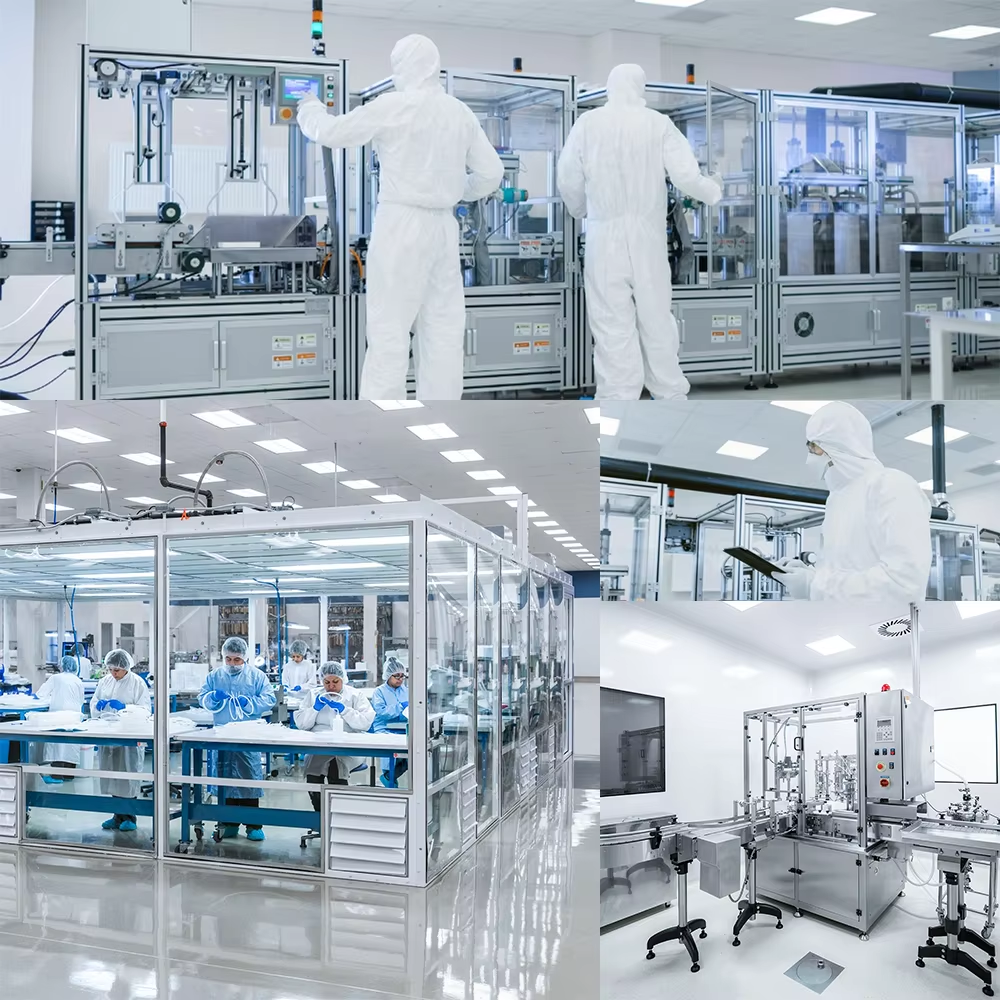
Cleanrooms represent controlled environments specifically created to keep airborne stuff like dust particles, microorganisms, and chemical fumes at bay. These facilities must adhere to those tough ISO 14644-1 standards regarding how many particles float around per cubic meter of air space. They achieve this through sophisticated filters and carefully managed air circulation systems that literally push out any unwanted particulates. Industries really depend on these special rooms when working with things like computer chips, medicine production, and medical device development because something as small as a speck of dirt can ruin an entire batch or mess up sensitive experiments. Regular office spaces just don't cut it here since standard building materials let all sorts of stuff seep in over time. That's why cleanrooms have those tight seals everywhere plus strict rules about what people wear and how long they can stay inside without causing problems.
Contamination control in cleanrooms is achieved through three integrated systems:
Together, these mechanisms create environments up to 1,000 times cleaner than hospital operating rooms—essential for applications like nanofabrication and sterile drug formulation.
The difference between hardwall and softwall cleanrooms really comes down to their construction and where they get used. Hardwall versions are built with solid panels typically made from steel, aluminum, or acrylic glass. These create completely sealed spaces that work best in environments needing ISO Class 5 certification or even tighter controls. The materials don't absorb contaminants thanks to their smooth surfaces and welded joints, which is why these rooms are so common in places like drug manufacturing facilities and semiconductor fabrication plants. Softwall options take a different approach altogether. They consist of flexible vinyl or polyester curtains attached to lightweight aluminum frames. This makes them much easier to set up quickly when space requirements change suddenly. Although they can't match the same level of cleanliness as hardwalls, many companies still find them useful for short term projects or situations where production needs might shift unexpectedly over time.
Softwall cleanrooms are best suited for organizations prioritizing adaptability and cost efficiency. According to the 2024 Cleanroom Technology Report, this segment is growing at an 11.5% CAGR, driven by startups and R&D labs needing scalable infrastructure. Key benefits include:
A 2023 industry survey found that 72% of biotech startups selected softwall systems to scale operations incrementally without overcommitting capital.
When it comes to facilities where contamination control is absolutely critical, hardwall cleanrooms still stand out as the best option available today. Built tough enough to meet those strict ISO Class 3 to 5 standards consistently, these rooms are pretty much required wherever vaccines get made, spacecraft parts come together, or any operation under Good Manufacturing Practice regulations. The combination of built-in heating ventilation systems, no-gap joints between panels, and floors coated with epoxy really cuts down on dust buildup inside by about 90% when compared to those cheaper softwall versions. Most places regulated by the FDA have gone this route too, since even though they cost more initially, these hardwalls typically last anywhere from 15 to 20 years before needing replacement, which makes sense financially over time while also giving peace of mind regarding compliance issues.
ISO 14644-1 stands as the go-to standard for classifying cleanrooms according to how many particles float around in the air. When FS 209E got replaced back in 2001, the new system switched to metric measurements counting particles per cubic meter instead of the old US customary units. The standard actually covers nine different classifications with specific limits set for various particle sizes ranging from 0.1 microns all the way up to 5 microns. Most industries have jumped on board with this framework, especially those making medicines, computer chips, and working with biological materials. Cleanroom designers, testers, and certifiers around the globe now follow these guidelines consistently. This helps keep things aligned across different countries' regulations while ensuring products meet quality standards no matter where they're manufactured.
The ISO classification system spans nine levels of cleanliness:
| ISO Class | Maximum Particles/m³ (0.1µm) | Maximum Particles/m³ (0.5µm) |
|---|---|---|
| 1 | 12 | Not defined |
| 3 | 35,200 | 1,020 |
| 5 | 3,520,000 | 29,300 |
| 8 | 35,200,000 | 2,930,000 |
An ISO Class 5 environment, commonly used in aseptic filling, allows no more than 29,300 particles 0.5µm per cubic meter. At the other end, ISO Class 9 permits up to 35.2 million particles 0.1µm/m³—comparable to regulated industrial settings.
Cleanliness standards that are higher actually need more air movement and better filtering systems. Take ISO Class 5 for instance it needs around 200 to 300 air changes every hour with almost full coverage from HEPA filters on the ceiling to keep those particles down to super low levels. On the flip side, ISO Class 8 spaces get by with just 5 to 15 air changes and only about 10 to 20% of the ceiling covered in filters. Every time air circulates through a room, roughly two thirds of what's floating around gets removed. That means how much air moves through determines how clean things stay. This becomes really important in places like semiconductor factories where even tiny defects at the micron level can ruin entire batches of products.
The Federal Standard 209E, or FS 209E for short, was put together by the U.S. General Services Administration back in the day. This became the go-to standard for cleanrooms between 1988 when it first came out and 2001 when they officially pulled it from service. The standard divided cleanroom environments into six different classes ranging from Class 1 all the way up to Class 100,000 based on how many particles measuring at least half a micrometer there were in each cubic foot of air. Even though this standard is now outdated, quite a few old specs still point to FS 209E, especially within certain parts of the American aerospace industry and defense manufacturing. Sometimes this creates headaches when trying to compare standards across different systems and regulations.
ISO 14644-1 introduced significant improvements over FS 209E:
| Feature | FS 209E | ISO 14644-1 |
|---|---|---|
| Units | Particles/ft³ (imperial) | Particles/m³ (metric) |
| Particle Sizes | Focused on 0.5 µm | Covers 0.1–5 µm in eight ranges |
| Classification | 6 classes (1 to 100,000) | 9 classes (ISO 1 to ISO 9) |
This expanded scope allows ISO standards to address modern needs, including detection of nanoparticles critical in semiconductor lithography and biologics processing.
While not exact, approximate equivalencies help bridge legacy and current standards:
These conversions highlight ISO’s enhanced precision; for example, ISO Class 3 limits particles 0.1 µm to just 1,000 per m³, reflecting tighter control than FS 209E Class 1’s focus on larger particles.
The ISO 14644-1 standard took over as the worldwide benchmark because it works with metric measurements, fits international rules better, and can actually spot those tiny particles right down to 0.1 microns. When nanotech started taking off along with all those new biopharma products, nobody could rely on the old FS 209E anymore since it just couldn't detect those super small contaminants below 0.5 microns. What really helped push ISO forward was how their standardized approach cut down on all the differences between regions. This meant companies operating across borders had an easier time meeting requirements everywhere they did business. After 2001 we saw this standard spread rapidly around the globe as more industries realized how much smoother operations became with consistent particle measurement practices.
Achieving ISO 14644-1 compliance follows a structured validation protocol:
Successful completion of all stages establishes baseline compliance before operational use.
Three core tests ensure ongoing cleanroom integrity:
These metrics are validated during initial certification and routine monitoring.
Per ISO 14644-2, most cleanrooms require formal recertification every six months, with weekly review of particle count logs. High-risk environments—such as sterile pharmaceutical production areas—demand continuous real-time monitoring and annual audits to meet regulatory expectations and ensure sustained compliance.
Cleanroom classifications align closely with industry-specific needs:
According to research published in 2024 about sustainable practices in cleanrooms, different industry needs really shape how these spaces get designed. Take semiconductors versus medical devices for instance. The semiconductor industry has standards that are actually 100 times more stringent when it comes to controlling particles compared to what's required for making medical equipment. And there's a price tag attached to this level of control. Facilities rated at ISO Class 3 end up using around 3.2 times the amount of energy as ones classified at ISO Class 8. So picking the right classification isn't just about meeting regulations or getting good results from processes. It's also about figuring out where to draw the line between strict requirements and actual operational costs.